

END OF FINANCIAL YEAR 2026
With significant payroll changes coming into effect this financial year-end, now is the time to get ahead of the deadlines — not scramble to catch up after them.
The EOFY 2026 deadline can arrive faster than expected — and 2026 brings with it a set of changes that are bigger than most. From a fundamental shift in how superannuation is paid, to the closure of a widely-used clearing house, to updated award rates that must be in place before your first pay run, there’s a lot to work through. Here’s what you need to know and when you need to act.
Payday super: the biggest EOFY 2026 change in years
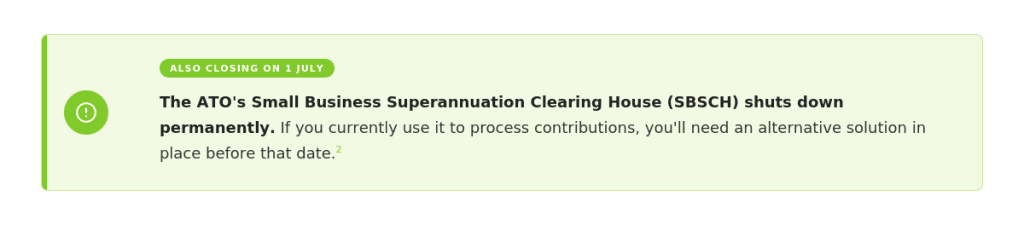
Starting 1 July 2026, the way employers pay super changes completely. Rather than making quarterly contributions, you’ll be required to pay superannuation on every single payday. Contributions must land in the employee’s fund within seven business days of each pay run — no exceptions.
This is a structural shift, not a minor tweak. One of the most important EOFY 2026 actions you can take is reviewing whether your payroll process is set up to handle frequent super payments. The ATO has guidance on what payday super means for employers and how to prepare.1
Award rate increases: act before the first pay run
Each year, the Fair Work Commission hands down its Annual Wage Review decision — typically in early June. Once published, updated award rates and the national minimum wage take effect from the first full pay period on or after 1 July 2026.3 For your EOFY payroll preparation, this means having updated rates loaded before your very first July pay run.
That timeline matters more than people realise. It means your payroll system must reflect the new rates before your first pay run of the new financial year — not after. Keep an eye on the Fair Work Commission website through June and move quickly once the decision is released. Failing to update rates in time means underpaying your employees, which creates compliance obligations you’d much rather avoid.
Click here to read about Minimum Wage increases July 1st 2026.
Key dates at a glance
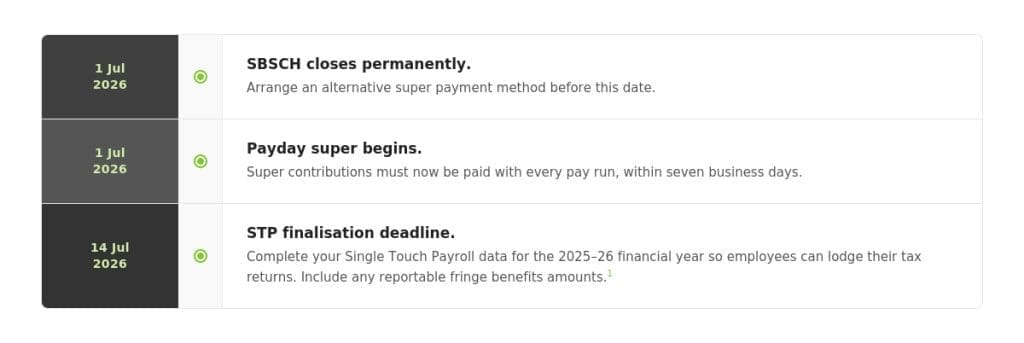
Getting across these EOFY 2026 deadlines now means you won’t be caught short in July. Accurate, on-time STP reporting matters year-round — every employee’s information must be submitted on or before each payday using STP-enabled software. Late or incorrect submissions can trigger penalties, so consistent reporting is the simplest way to stay compliant.
Your End Of Financial Year 2026 Checklist
Beyond the headline changes, a thorough year-end close-out covers the full picture of your business finances. Work through these areas before you wrap up the financial year:
- Pre-year-end financial review
- Cash flow & asset management
- Documentation & record keeping
- Bank record reconciliation
- Payroll & payment records
- Lodgement & compliance

Free printable checklist All six areas in a single print-ready PDF — tick off each item as you go
The businesses that find end of financial year manageable are the ones that start preparing early. Get your payroll software updated, sort out your super payment process, and mark those key dates in your calendar now — so July arrives as a routine close-out, not a last-minute scramble.
Not sure where to start?
Navigating payday super, STP finalisation, and award rate updates all at once is a lot to manage. If you’d like a hand making sure your business is ready before 1 July, reach out to our team — we’re happy to walk you through it. Get in touch with our team today.
REFERENCES
- Australian Taxation Office — Single Touch Payroll & Payday Super ato.gov.au — Single Touch Payroll
- Australian Taxation Office — SBSCH Closure ato.gov.au — Get ready for the SBSCH closure
- Fair Work Commission — Annual Wage Review 2026 fwc.gov.au — Annual Wage Review 2026
Share this article