

Starting a business is one of those rare moments where excitement and overwhelm arrive at exactly the same time. You’ve got an idea, maybe even a plan, but buried underneath the enthusiasm is a quiet question: am I doing this right? The good news is that the Australian Taxation Office has mapped out the key steps to get you started on solid footing. Here’s what you need to know, about ATO business compliance in plain language.
First Things First: Are You Actually Running a Business?
This might sound like an odd place to start, but not every money-making activity counts as a business in the eyes of the ATO. Selling old clothes on Facebook Marketplace? Probably not a business. Consistently buying and reselling items for profit, with regularity and a commercial purpose? Now we’re in different territory. The ATO uses a set of indicators to determine whether an activity is a business or a hobby. Key factors include whether you intend to make a profit, whether your activity is carried out in a business-like manner, and whether it’s repeated and regular. Getting these right early matters, because the tax obligations are very different.
Not sure if you’re running a business or a hobby? The ATO has an online tool to help you work it out: ato.gov.au → search “Business or hobby”.
Do Your Homework Before You Start Trading
Once you’ve confirmed you’re heading into business territory, there’s meaningful groundwork to lay before you officially start trading. This includes understanding your tax obligations, superannuation requirements, and what registrations apply to your situation. Think of it like building a house, you wouldn’t skip the foundations just because you’re eager to move in. Getting across your obligations before you start is far easier than untangling things once you’re already operating.
Step One: Get Your ABN
An Australian Business Number (ABN) is an 11-digit identifier that your business uses when dealing with the ATO and other businesses. You’ll need it to:
- Invoice clients and customers
- Register for GST (if applicable)
- Avoid having tax withheld at the top rate by businesses you work with
- Register a business name
Applying for an ABN is free and done through the Australian Business Register at abr.gov.au. It takes around 15 minutes if you have your information ready. Most applicants receive their ABN immediately.
Do You Need to Register for GST?
GST registration is compulsory once your business turnover reaches $75,000 per year (or $150,000 for non-profit organisations). If you’re below that threshold, registration is optional, but once you register, you must lodge a BAS and remit GST to the ATO. If you register for GST voluntarily, which some businesses do to claim GST credits on their expenses, you’re committing to the associated reporting obligations. It’s worth thinking through before you opt in.
Your Business Structure Matters More Than You Think
Sole trader. Partnership. Company. Trust. Each structure comes with a different set of rules, responsibilities, and tax implications. Here’s a quick overview:
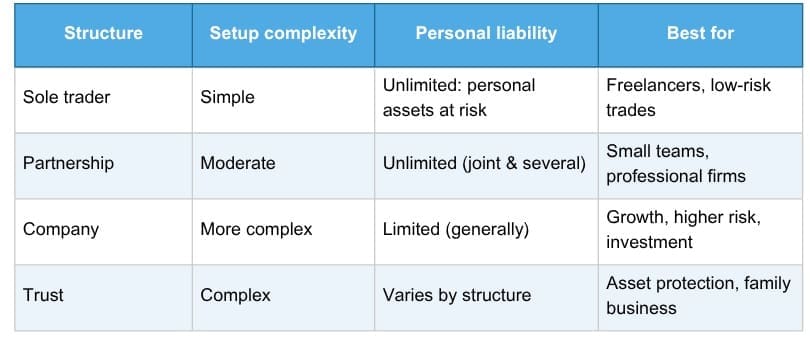
A sole trader setup is simple and inexpensive to establish, but your personal and business assets are legally the same, meaning personal exposure if something goes wrong. A company structure offers more protection and can be better suited to growth, but comes with more complexity and compliance requirements.
Choosing the right structure for your goals and risk tolerance is one of the most consequential early decisions you’ll make. This is genuinely worth a conversation with an accountant or registered tax agent before you commit, it’s outside the scope of BAS services, but the right advice early can save significant cost and complexity later.
Thinking About a Franchise? There’s More to Consider
Franchising is an appealing path for many aspiring business owners, you get a proven model and an established brand. But the tax and compliance side of franchising has its own nuances, including how franchise fees are treated for GST, your obligations as a franchisee versus the franchisor, and what’s included (and not included) in the franchise agreement when it comes to your own reporting. Don’t assume the franchisor will handle your tax obligations. Understanding what you’re responsible for is still on you.
Build Good Habits From Day One
Here’s the thing about ATO business compliance: the people who find it stressful are usually the ones who let it pile up. The people who find it manageable are the ones who built systems early. That means:
Keeping accurate records from the moment you start trading, not scrambling at BAS or tax time. The ATO requires most business records to be kept for five years.
Using accounting software to track income, expenses, and GST automatically. Platforms like Xero, MYOB, and QuickBooks make this straightforward and keep your records audit-ready.
Understanding your super obligations early, if you have employees (or certain contractors), you’re required to pay superannuation guarantee contributions. The current rate is 11.5% for 2024–25, rising to 12% from 1 July 2025.
Getting good advice early, whether from a bookkeeper, accountant, or business advisor. The right support at the start pays for itself many times over.
These aren’t just box-ticking exercises. Good financial habits give you a clearer picture of how your business is actually performing, and that information is genuinely valuable when you’re making decisions about growth, staffing, or investment.
The Bottom Line
Starting a business doesn’t have to mean navigating tax and compliance alone. The ATO provides a range of guidance, tools, and resources specifically designed to help new business owners get it right from the start. Take the time to understand your obligations before you launch. Your future self, at BAS time, tax time, or when you’re applying for a business loan, will thank you.
Need Help Getting the ATO business Compliance Side Right? Talk to T3 Partners.
Once your business is up and running, keeping on top of your bookkeeping, payroll, super compliance, and BAS obligations is where T3 Partners can make a real difference. As a registered BAS Agent, T3 Partners can:
- Manage your BAS lodgements accurately and on time, with extended deadlines only BAS Agents can access
- Handle your payroll processing and superannuation compliance
- Set up and maintain your bookkeeping systems so your records are always in order
- Keep your accounts reconciled so you always know where your business stands
For advice on business structure or income tax, we’ll point you in the right direction, but when it comes to keeping your day-to-day compliance on track, we’ve got you covered.
Get in touch with the team at T3 Partners today.
Frequently Asked Questions
Do I need an ABN before I start trading?
You don’t legally need an ABN before you start, but it’s strongly advisable to get one first. Without an ABN, other businesses are required to withhold 47% of any payment to you, the top withholding rate. An ABN is free and quick to obtain at abr.gov.au.
What’s the difference between a bookkeeper and an accountant?
A bookkeeper manages your day-to-day financial records, transactions, payroll, reconciliations, and BAS lodgements. An accountant typically handles higher-level work such as tax returns, financial statements, and strategic advice. Many businesses use both. A registered BAS Agent like T3 Partners sits within the bookkeeping and compliance space.
When do I need to register for GST?
As soon as your annual turnover reaches $75,000 (or $150,000 for non-profits), GST registration is compulsory. You must register within 21 days of reaching the threshold. If you think you’ll reach it soon, it’s worth registering early rather than scrambling later.
Can I change my business structure later?
Yes, but it can be complex and may have tax and legal implications. Changing structure often involves new registrations, transferring assets, and potentially triggering capital gains tax. It’s much easier to get the structure right at the start, speak with an accountant or registered tax agent before you decide.
This post draws on information from the ATO’s “Ready for Business” resource and the Australian Business Register. It is intended as general information only and does not constitute tax, legal, or financial advice. For guidance specific to your circumstances, please consult a registered tax agent or accountant. Source: ato.gov.au, abr.gov.au.