
If your business is registered for GST, Business Activity Statement (BAS) lodgement is one of those non-negotiable obligations that comes around every quarter. Miss it, and the ATO, Australian Taxation Office, takes notice. Get it right, and it’s simply part of running a well-organised business. Here’s everything you need to know.
What is a BAS?
A Business Activity Statement is a form you submit to the ATO to report and pay a number of tax obligations in one go. It’s the ATO’s way of collecting tax throughout the year rather than waiting until your annual return.
Your BAS brings together several obligations in a single lodgement. For most small businesses, that includes:
- GST collected and paid
- PAYG withholding (tax withheld from employee wages)
- PAYG instalments (prepayments toward your income tax liability)
Who needs to lodge a BAS?
You need to lodge a BAS if your business is registered for GST. In Australia, GST registration is compulsory once your annual turnover reaches $75,000 (or $150,000 for non-profit organisations). However, even if your turnover is below that threshold, you may choose to register voluntarily. If you are registered, you must lodge, there’s no opt-out once you’re in the system.
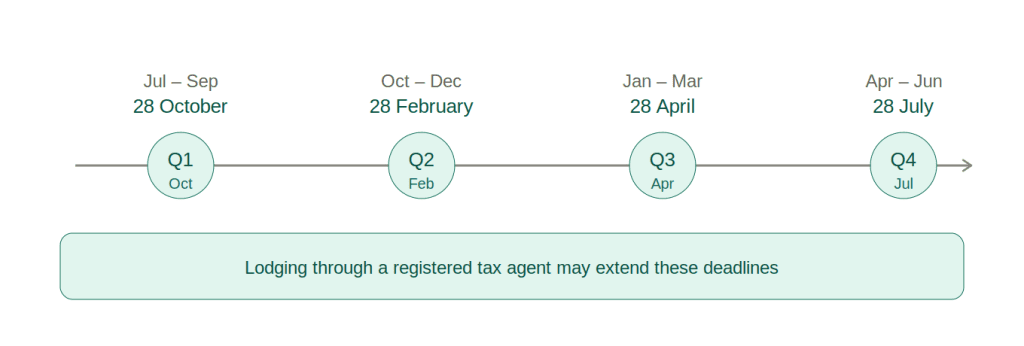
When is a quarterly BAS due?
For quarterly lodgers, the ATO sets four deadlines each financial year. Each covers a three-month period and is due roughly one month after that period ends. Importantly, if you lodge through a registered BAS Agent like T3 Partners, you may be entitled to extended due dates, one of the practical advantages of working with a professional.

What does a BAS include?
For most quarterly lodgers, a BAS lodgement will cover the following:
GST
The difference between the GST you collected from customers and the GST you paid to suppliers. If you collected more than you paid, you owe the difference to the ATO. If you paid more than you collected, you may be entitled to a refund.
PAYG Withholding
If you have employees, you report and pay the tax you withheld from their wages during the quarter.
PAYG Instalments
If the ATO has entered you into the PAYG instalment system, which can apply to sole traders, company directors, investors, and others whose tax payable on business or investment income exceeds the ATO’s threshold, you will also prepay toward your end-of-year income tax liability through your BAS.
Not every BAS will include all of these. Your specific obligations depend on your business structure and ATO registration details.
What happens if you lodge late?
Missing a BAS deadline is not something the ATO overlooks. Late lodgement can result in a failure-to-lodge (FTL) penalty. The ATO calculates FTL penalties in units, with each penalty unit currently set at $313 (as of the 2024–25 financial year). The minimum penalty for a late BAS is one penalty unit, with amounts increasing the longer the lodgement remains outstanding. However, if you realise you’ve missed a deadline, act quickly. The ATO does consider voluntary disclosure favourably, and a registered BAS Agent can often assist in seeking a reduction in penalties.
Practical tips to stay on top of your BAS
Reconcile your accounts monthly. Don’t wait until the end of the quarter to check your figures. A quick monthly reconciliation means your BAS preparation takes minutes rather than hours.
Keep your receipts and invoices organised. Whether you use a folder system or accounting software, having clear records of income and expenses makes BAS time straightforward.
Use accounting software. Platforms like Xero, MYOB, and QuickBooks automatically track GST on each transaction. Your BAS figures are ready to review at the click of a button.
Set calendar reminders. Mark all four due dates at the start of the financial year. Better yet, set a reminder two weeks before each deadline so you have time to prepare without rushing.
Separate your GST. Consider holding GST funds in a separate bank account as you collect it. This way, you’re never caught short when the payment is due.
The bottom line
BAS lodgement on time every quarter is one of the most important compliance habits a business can build. For most businesses, it becomes routine, especially with the right tools and support in place. If you find BAS preparation stressful or time-consuming, that’s a sign you could benefit from professional help. A registered BAS Agent not only takes the task off your plate but also gives you access to extended deadlines and the peace of mind that everything has been lodged correctly.
Frequently Asked Questions
Do I need to lodge a BAS if I had no income that quarter?
Yes. If you are registered for GST, BAS lodgement must be completed every quarter even if your business had no activity. You simply report zero figures. Failing to lodge a nil BAS can still result in a penalty.
Can I lodge my BAS online?
Yes. You can lodge through the ATO’s Online services for business, the ATO app, or directly through your accounting software. Alternatively, your registered BAS Agent can lodge on your behalf.
What if I make a mistake on my BAS?
Mistakes happen. Minor errors under $10,000 can generally be corrected on your next BAS. For larger errors, you’ll need to submit a revised BAS or contact the ATO directly. Your BAS Agent can help you manage this process.
What records do I need to keep?
The ATO requires you to keep records for five years. This includes tax invoices, bank statements, and any documents that support the figures on your BAS.
Is the BAS the same as a tax return?
No. Your BAS covers ongoing tax obligations throughout the year, such as GST and PAYG. Your annual income tax return is a separate lodgement that covers your overall income and deductions for the financial year. Note that T3 Partners, as a registered BAS Agent, handles BAS lodgement, income tax returns require a registered tax agent.
Need Help With Your BAS?
BAS lodgement doesn’t have to be something you dread every quarter. The team at T3 Partners can handle your BAS from start to finish, accurately, on time, and with extended deadlines that only registered BAS Agents can access. Get in touch with the team at T3 Partners today.
This blog post is intended as general information only and does not constitute tax or legal advice. For advice specific to your circumstances, please contact us directly. Source: Australian Taxation Office (ato.gov.au).